KØBENHAVGATA 4A
0460 Oslo
post.at.k4galleri.no
K4
Your Custom Text Here
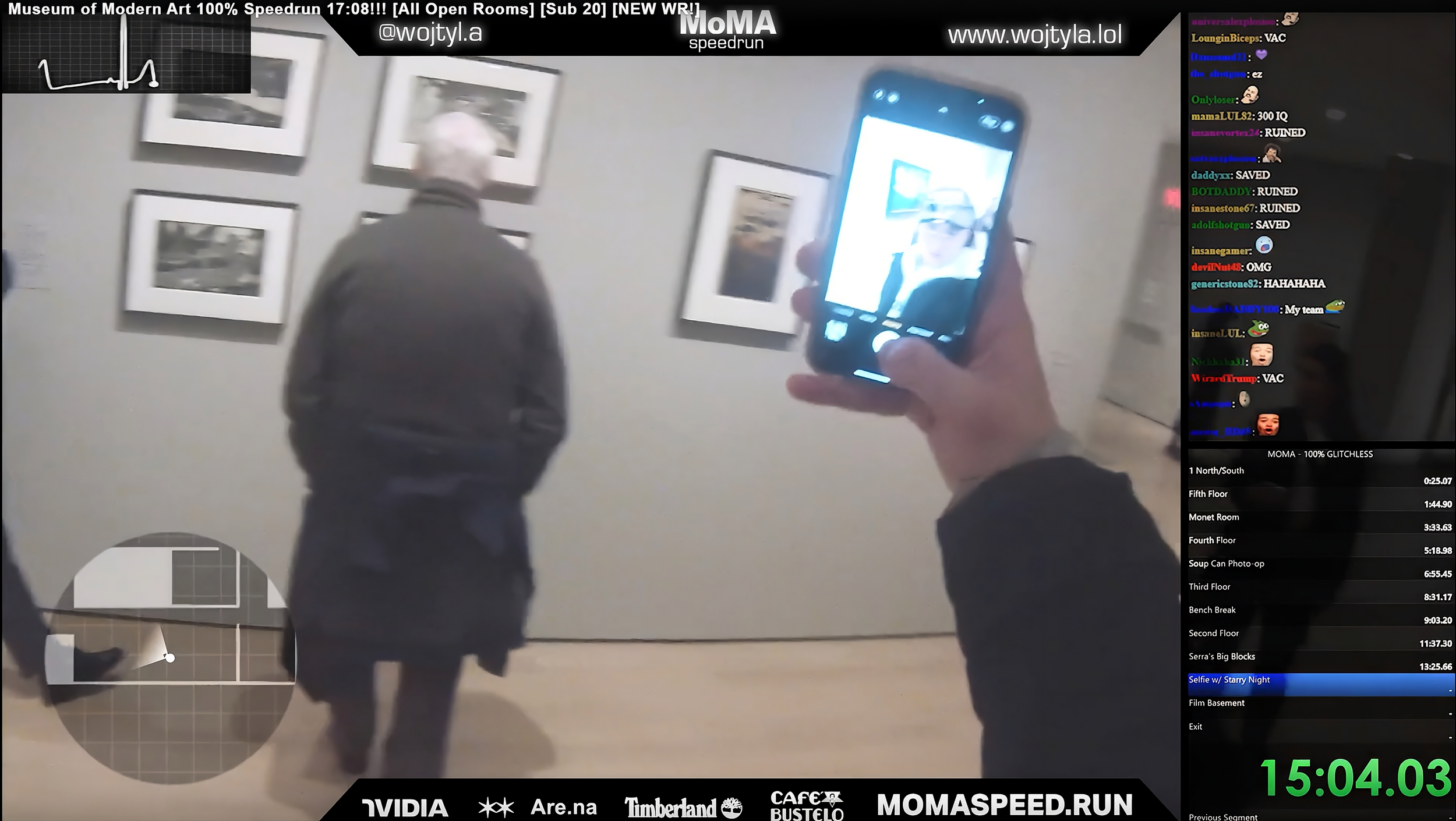
With a Go Pro to his Cap, Wojtyła moves through MoMA with one goal: to see all the works as quickly as possible. The museum visit becomes a form of performative act, an action governed by speed, efficiency, and documentation.
At the outset, an overarching perspective of the city is established, a view from above that both orients and distances. This can be read as a form of self-surveillance. We register, map, and share our own movements through technological interfaces. Reality increasingly appears as material, and we actively participate in the production of data that can be collected, analyzed, and circulated. This logic is intensified in the emergence of streaming culture, where life is no longer merely documented in fragments but presented as continuous flows. We are not only experiencing reality, but actively producing it as content.
At the same time, the project makes visible how surveillance has become an integrated part of everyday life. As Wojtyła films his way through the museum, he also records everyone else present. Surveillance, which is usually hidden within systems and infrastructures, here becomes explicit and embodied. To walk, to see, to film, and to share appear as the same action. What appears as voluntary documentation can simultaneously be understood as a form of data distribution to the platforms that structure visibility — a practice in which we are both users and producers within systems we do not have access to.
The question that remains is what happens to our ability to experience, interpret, and dwell when art itself is subjected to this logic?
Brennan Wojtyła (Florida, 2001) is a Berlin-based artist. His work draws from internet culture to build situations that blur the line between participant and spectator. His MoMA Speedrun (2025), completed in under 20 minutes, went viral and remains a world record.
The exhibition is curated by Mateo Jimenez Tilrem.
Quisque iaculis facilisis lacinia. Mauris euismod pellentesque tellus sit amet mollis.